

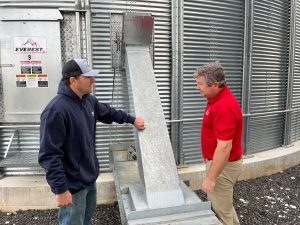
Every year, Ivers Farms harvests corn and soybeans from approximately 11,000 acres in southeast Illinois and southwest Indiana. They store most of that grain on the farm. So it’s important they have the storage capacity and speed to keep their combines and trucks running.
Reese Ivers recently described how their latest grain system installation near St. Francisville, Illinois, helps Ivers Farms keep up with their growing needs. The new equipment consists of a 200,000 bushel Brock EVEREST® Grain Bin and a 10,000 bushel an hour Brock bucket elevator which serves the new bin plus an existing 146,000 bushels of storage that was already on-site.
Strong storage and gentle handling.
“We’re getting ready to fill that bin up for the third time and use that new leg and hopper,” said Reese. “All of our new bins that we’ve gotten over the past several years have been Brock. They’ve been good quality and had no issues. One of our other bins right next to the new Brock bin did get dented in a derecho, so we weren’t able to use it last fall.”
“Our Brock dealer, RIPCO, was able to repair it. While they were doing that, we had them put in a Brock drag conveyor underneath. I think this is the first one we’ve had with a drag underneath the floor, which is gentler on the grain and lets us empty from outlets all the way across the bin.”
Efficient harvest.
The new grain leg is a Brock bucket elevator supported by Brock’s LeMar® tower. “I like having the tower instead of guy wires like we have at some of our other locations.” said Reese. “The bucket elevator is great, and it’s fast too.”
“The speed is a big deal. You can have two trucks keeping up with your combines instead of three or four. That’s big on your efficiency, which is the name of the game, not having to stop and wait. It’s a heck of a lot quicker just to be able to pull over a pit and let it go. Especially with that fast of a leg. It can keep up with a corn combine harvesting 5,000 bushels an hour.”
Fast unloads.
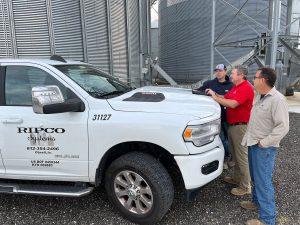
When it’s time to take the grain to market, Ivers Farms runs six trucks nonstop, hauling grain to an elevator 60 miles away. First, they use side-draw discharge chutes on the Brock bin to unload. “You want to use the side chutes until you can’t,” said Reese. “Gravity is free; you don’t have to use electricity to get the corn out.” The rest of the grain is unloaded using a horizontal drag conveyor under the bin floor, which sends grain through the bucket elevator to their 8,000-bushel overhead load-out hopper bin.
The Ivers system also has automatic shutoffs on their grain leg and unload. “When we start pulling grain out of the middle of the bin into the hopper, we just let that run. It hits a sensor and has a timer on the leg that automatically shuts the system off. You don’t have to have a guy sitting there babysitting it. So that hopper is full and ready to go when the trucks get there. The drivers can just load themselves up and don’t have to wait on each other. You’re in and out a lot faster, and you get a lot more loads done.”
Installation and support.
Ivers Farms’ new grain system was installed and is serviced by RIPCO Systems in Otwell, Indiana. It is a third-generation family-owned business founded in 1962 by Gerald “Rip” Sorgius. Today the company is operated by Rip’s son, Gary Sorgius and his sons, JD and BJ Sorgius. They have an experienced team that’s able to offer timely installation and service support for every type of grain system.
“We’ve been installing Brock material handling equipment just as long as we have the Brock storage bins,” said JD. “It’s well-built commercial equipment that goes together very well and gives the customers exactly what they’re looking for. Something that is robust, has capacity, and provides longevity.”
The Ivers expansion included a Brock 60-foot by 30-ring commercial bin with an underfloor drag conveyor, a Brock 10,000 bushel bucket elevator, a LeMar® support structure, a Brock catwalk with a horizontal drag conveyor, a new receiving pit, and a Brock 18-foot commercial overhead load-out tank placed on a custom-made superstructure. The site had sandy soil, so the foundation required excavation and filling with rock for stability. The installation took about two and a half months to complete.
“Anytime we need bins, we go to RIPCO because we know they’re going to do it right,” said Reese. “They’re going to do a good job and get it done on time.”
Watch a $1.8 million grain system being built from start to finish.
Maurice Ivers Sets New Mark for Shucking
These days, the Ivers harvest up to 5,000 bushels of corn an hour. But back in 1940, Reese’s grandfather, Maurice Ivers, husked 213 bushels of corn by hand in one day to win the Indiana corn-shucking competition. His effort filled seven wagons, surpassing all previous records. So you could say that corn husking runs in the family. Reese works alongside his dad Dennis, uncle George, brother Garrett, and cousin David. They are the third and fourth generations to farm in Illinois and Indiana starting in 1938.
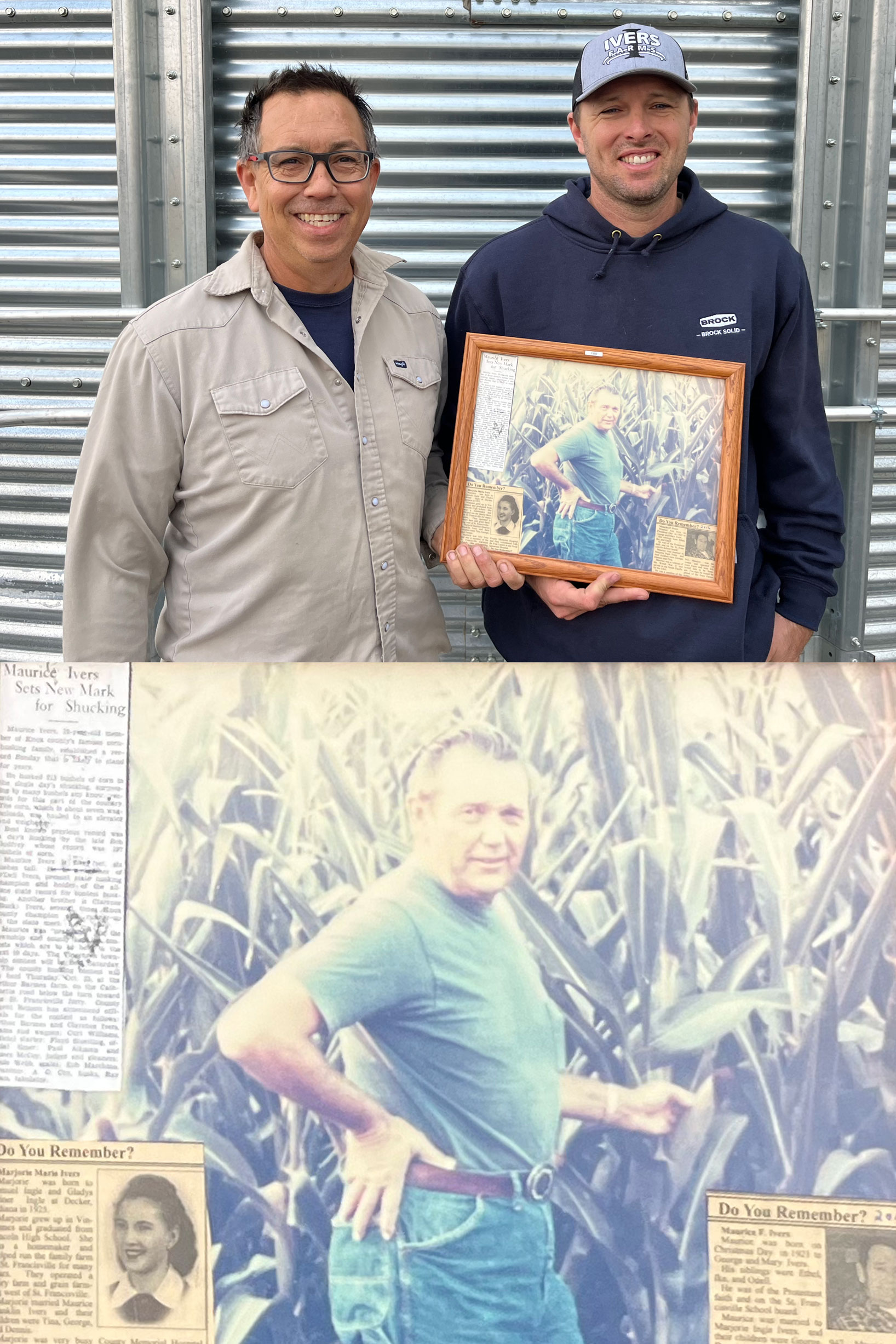
David Ivers and Reese Ivers with a photo of their grandfather, Maurice.
Learn more about BROCK Storage and Handling.